
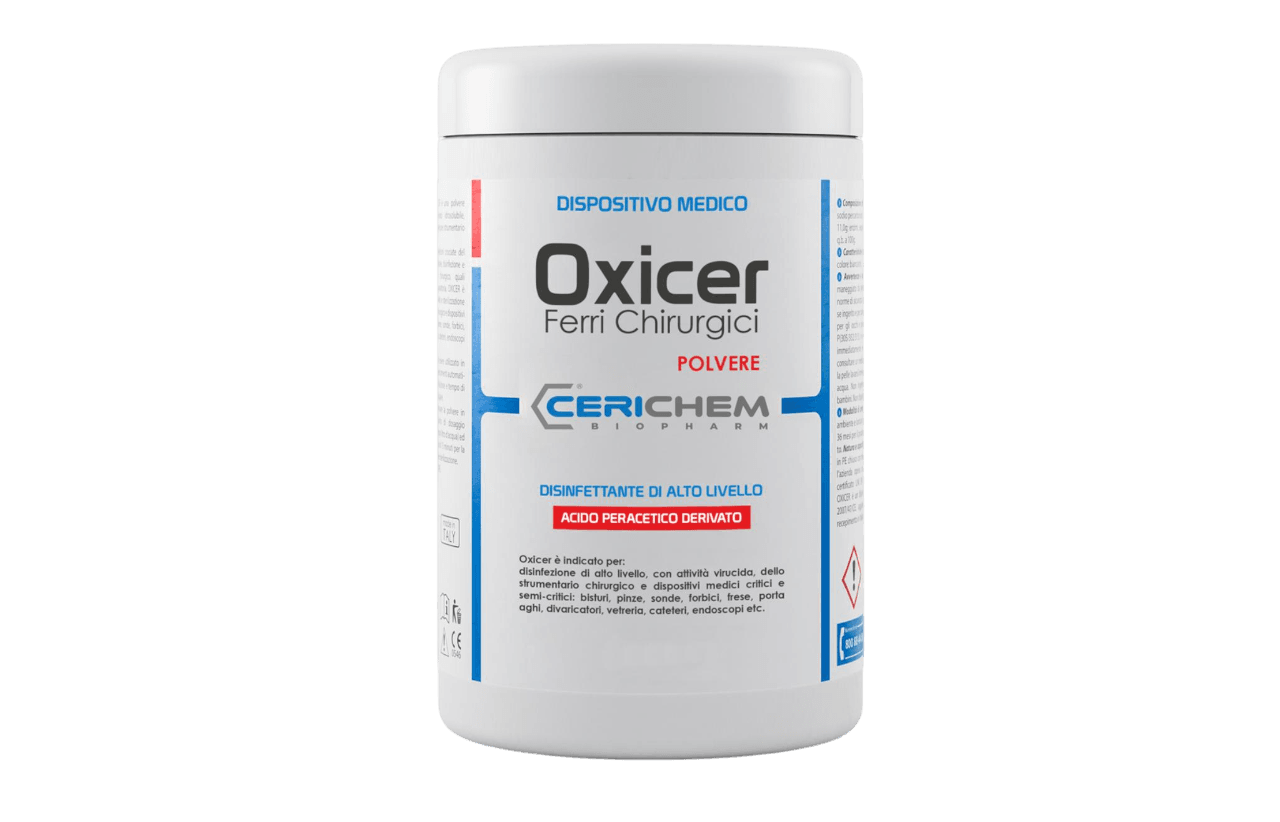
- 100 g contain: sodium percarbonate 53 g, tetraacetylethylenediamine (TAED) 23 g, anhydrous citric acid, enzymes, chelating agents, stabilizers, alkalizing agents and corrosion inhibitors.
Peracetic acid (active oxygen), formed by the reaction between hydrogen peroxide (released from sodium percarbonate dissolved in water) and tetraacetylethylenediamine (TAED), provides OXICER with significant biocidal activity against spores, viruses, bacteria, mycobacteria (Mycobacterium tuberculosis, TBC) and fungi. To document and confirm the product’s characteristics, the following tests were carried out in accordance with EN 14885:2015:
- VIRUCIDAL ACTIVITY
Applied method: EN 14476. Quantitative test for evaluating virucidal activity on instruments used in the medical area. - BACTERICIDAL ACTIVITY
Applied method: EN 13727 – EN 14561. Quantitative test for evaluating bactericidal activity on instruments used in the medical area. - FUNGICIDAL ACTIVITY
Applied method: EN 13624 – EN 14562. Quantitative test for evaluating fungicidal activity on instruments used in the medical area. - MYCOBACTERICIDAL ACTIVITY
Applied method: EN 14348 – EN 14563. Quantitative suspension test for evaluating mycobactericidal activity on instruments used in the medical area, in the presence of interfering substances. - SPORICIDAL ACTIVITY
Applied method: NFT 72-190 – EN 13704. Quantitative suspension test for evaluating sporicidal activity on instruments used in the medical area, in the presence of interfering substances.
Based on this activity, the formulation acts as both a decontaminant and a high-level disinfectant.
MATERIAL COMPATIBILITY DATA
OXICER solutions are compatible with the main materials used in medical equipment: rubber, glass and porcelain. The solution can be used on all metals except copper, brass, zinc and iron. It does not cause corrosion on stainless steel instruments.